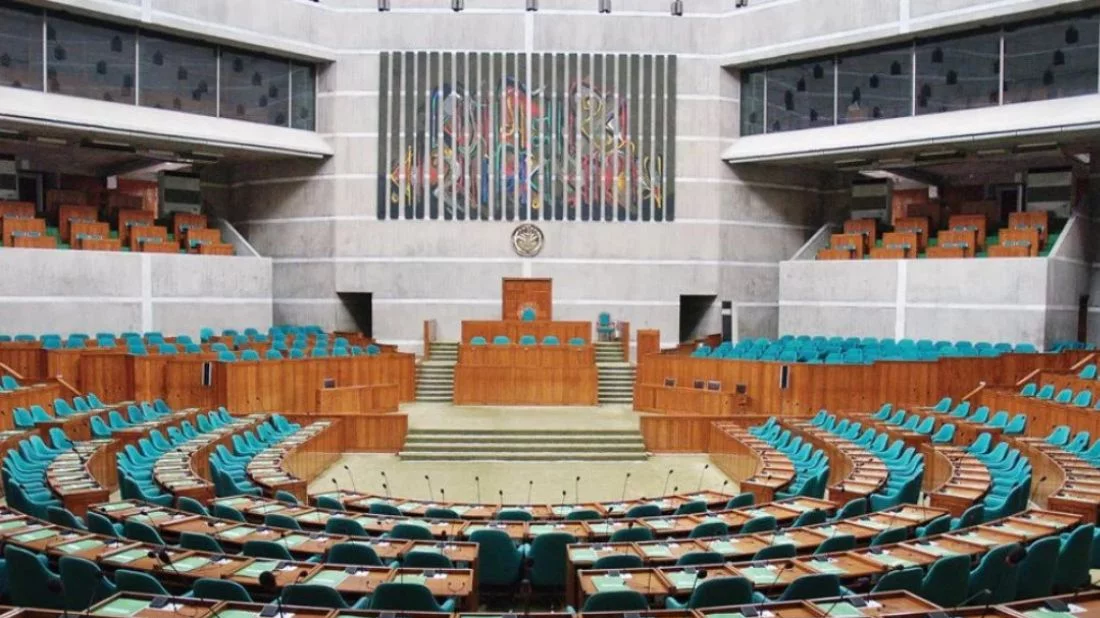
Concept and functions of proposed upper house. This is the concluding part of a two-part series
The basic concept could then be as follows.
One of the two chambers would be relatively unchanged, a lower house consisting of politicians who have won from their constituencies in free and fair elections. The majority party in the lower house then forms the government with its leader taking the post of prime minister.
The upper house would not undertake programs of its own — because, being unelected, it has no mandate from the people for such measures
The other chamber would be the upper house made up of say, 11 nominated members sitting in permanent session whose role would be to act as a check on the activities of the lower house. The upper house would not undertake programs of its own — because, being unelected, it has no mandate from the people for such measures.
In other words the lower house, being the centre of both legislative and executive power, would remain a strong, active body. This is vital as it gives the prime minister the means to deliver on the election promises made to the electorate. The last thing we should promote is an upper house which is too powerful and interferes needlessly in the activities of the lower house.
That is why the upper house should not itself be an elected body, as experience all over the world shows that two elected political institutions tend to create blockages and lead to inefficient overall governance. (See for example the recent history of Tunisia in which two poles holding significant power, the prime minister and the president, who were both elected, failed to work together with the result that today the president has taken over completely and rules as an autocrat.)
The Bangladesh upper house would be designed to be an unelected, nominated body, serving as a relatively limited, passive institution which would tend to come into play mainly to lop off any excesses that the lower house and its prime minister may stray into. The upper house’s main source of power will be persuasion, which becomes more powerful the more it is able to mobilize public and media opinion to counter egregious, unreasonable behaviour by the lower house and its leader.
Composition of upper house
The upper house will be made up of 11 members.
The members of the upper house will be nominated by a special committee headed by the chief justice of the Supreme Court.
They will be persons …
- a) Of the highest integrity and renown in their own professional fields, who have had long unblemished careers
- b) Who are politically neutral, having no formal or informal ties to any established political party
They will be appointed for a single 10-year term. They will be expected to be 60 years old or above. They could be from a diverse mix of backgrounds such as business, professional, NGO, academic, media, ex-military and so on. Gender, minority, provincial and ethnic representation would be assured as far as possible.
It will be seen that these are roughly the same selection principles that were applied in the past when appointing members of caretaker governments. The nominations that were then made through this process were generally well received by the public and the people so appointed were considered worthy of having been selected, rarely provoking controversy.
Special note about age limit
Why should people younger than 60 not be considered for appointment as members of the upper house? This goes to the heart of the role of the upper house. Its members are expected to be near the end of their distinguished careers and on the verge of retirement because they will by then have become known quantities. At the same time given their passive, oversight role the members of the upper house should not themselves be involved in active pursuits intended to advance their personal goals. Otherwise conflicts of interest could arise which would get in the way of their need to be neutral in all matters. In terms of the metaphor used earlier in this piece the upper house members should be “referees” only, and not want to be themselves among the “players.”
On the other hand, younger people interested in leadership roles, such as gifted students or upcoming professionals, should aspire to roles in the active sector, take part in political work and become members of the lower house which is where the bulk of the actual governance of the country will continue to take place.
Two functions of upper house
- Legislative functions
The upper house would not itself have the power to initiate legislation but all Bills passed by the lower house, including the Financial Budget, would need to be approved by a simple majority of the upper house before coming into force. If not so approved, the lower house would have the right to overturn the upper house decision by a two-thirds majority vote, except for the provisions relating to the upper house’s own budget. Otherwise the prime minister could cripple the upper house by cutting off its funds.
The upper house would be free to hold hearings on bills and the prime minister and cabinet ministers could argue in favour of their proposed measures. The leader of the opposition and other MPs could be invited to give their views. Independent experts could also be consulted as required. The effect of such scrutiny would be two-fold:
- The ruling party in the lower house would be forced to limit the range of its legislative options to those which fall within the mainstream of the country’s economic and social life. For example, the unconscionable Digital Services Act would probably never have been approved by an upper house constituted as suggested above. Obviously egregious legislation would probably never even have been considered at all if a potential check had been in place, under the influence of what has been described above as a “deterrent effect”. The prior elimination of such extremist choices can only be healthy for the political life of the nation taken as a whole.
- The mere existence of an upper house would tend to moderate the behaviour of the opposition who could recognize in it the elements of a “court of appeal.” Thus if, for example, a major issue, such as gas export, were being discussed in the lower house the opposition’s arguments in such a debate would not fall totally on deaf ears. Even if the ruling party steamrollered the opposition in the lower house there would still be the possibility of another hearing of the issues in the upper house. In this way the opposition would be given some, albeit limited, powers of redress and so, to that extent, the political game of maneuvering would be revived. At the same time if the upper house upheld the ruling party’s proposed legislation this would tend to serve as re-assurance that the nation’s interests were not being sacrificed to illegitimate considerations.
In this way the opposition’s incentives to resort to violent street agitation would be reduced, if not totally eliminated. Under these circumstances if the opposition persisted in extra-Constitutional action it would be condemned on all sides and such defiance rendered ineffective in the eyes of the media and the general public.
The upper house thus serves as a “safety-valve” which siphons off the kind of excessive pressures which otherwise tend to build up in a unicameral system (in which winner takes all, and the loser is left totally subjugated).
- b) Oversight functions
In addition to the legislative functions specified above the upper house should be responsible for a number of government commissions (many existing and a few new ones). These are what may be thought of as “accountability functions” (term suggested by Mirza Hassan, BIGD). The common factor among them is that each of these commissions is tasked to scrutinize critical areas of national activity and to ensure that the relevant laws and regulations are being strictly followed. In the past the governments of the day have often interfered in the workings of these Commissions to such an extent that they have not been able to carry out their duties honestly and properly. It is accordingly proposed that in future these Commissions should report only to the upper house so that the civil bureaucracy or ruling party politicians do not have the scope any longer to influence the day to day work of any commission.
These commissions could be the following:
- Election Commission: All activities related to holding elections in Bangladesh, both national and local, including delimitation of constituencies.
- Anti-Corruption Commission: All activities related to identifying and investigating potentially corrupt transactions in the public and private sectors.
- Human Rights Commission: All activities related to protection of human rights.
- Public Service Commission: All activities related to recruitment of civil servant services personnel.
- Right to Information Commission: All activities related to requests for government information made by members of public and journalists.
- Office of the Comptroller and Auditor General of Bangladesh: All activities related to audit of government receipts and expenditure, as well as relevant analysis.
- All institutions producing national statistics, which have been grossly manipulated by politicians in recent times.
- Media Regulation Commission (new body): All activities related to regulation of media activities, including digital media.
- Censorship Commission (new body): All activities related to censorship of entertainment, cultural and literary activities, including their digital forms.
The upper house will in this sense “protect” these commissions from any undue pressure upon them and enable them to work in peace to deliver the aspects of accountability for which they have been constituted. This kind of ring-fencing by the upper house of certain clearly delineated sectors would not in any way hamper the executive branch’s ability to carry out its own positive activities, namely administration of the various government ministries and carrying out national economic development, which is already a huge and complicated task.
Ruling ethos
Every Constitutional arrangement is more than the bald words on the page. Over time a certain ethos emerges which shapes the manner in which the provisions of the Constitution are actually carried out. Accordingly it is to be hoped that the ethos which will inform the working of the proposed upper house in Bangladesh is that it will tend to allow the lower house and the prime minister a large measure of authority. After all, the members of the lower house are directly elected representatives of the people and they should enjoy a degree of freedom of action commensurate with such a mandate
The upper house should conceive its role mainly to be that of a watchdog, stepping in only when it appears that the government is going seriously off the rails. The last thing anyone would want is to see the upper house become a source of permanent and unreasonable blocking action, which ends up paralyzing the government.
The ultimate basis-moral authority
This then is the point, that the upper house will need to derive its power largely on the basis of its moral authority, exercised in full view of the citizens of the country. In fact this is exactly the basis on which past caretaker governments have performed their tasks in Bangladesh. It is interesting to note that the concept of a “council of elders” does actually have roots in our nation’s ancient anthropological practices (as in the practice of Shaa’lish). What is being proposed in this paper is only to re-invent it in a modern context! There is no reason at all that the state’s governance should not benefit from a body which is a repository of the nation’s traditions, collective experience and mature wisdom.
Need for an enlightened trade-off
It is devoutly to be wished that, to avert the prospect of recurring bouts of violent instability, the professional politicians of the country will find it in their hearts to agree to the small but significant diminution in the powers of the lower house caused by the setting up of an upper house along the lines discussed here, which could be of the order of 70% in future instead of 100% today.
A ruling party may resent this additional constraint but it could find itself grateful for the safeguards afforded by an upper house if one day it becomes a party in opposition
The members of such an enlightened political class will surely see that the gain in the prospects for a peaceful, sane and healthy governing system in Bangladesh more than justifies such a trade-off. A ruling party may resent this additional constraint but it could find itself grateful for the safeguards afforded by an upper house if one day it becomes a party in opposition.
After all, the players of any game would always want a neutral referee to adjudicate the proceedings. Without some agency taking on this essential role, that of an arbitrator, the rules will not be respected, leading inevitably to chaos. May we all be wise enough to see that, for the sake of future generations, a sacrifice made today may prove a saviour tomorrow.
Salahdin Imam is a Harvard graduate in political and social science with a special interest in Comparative Social Theory. Email: salimam32@yahoo.com