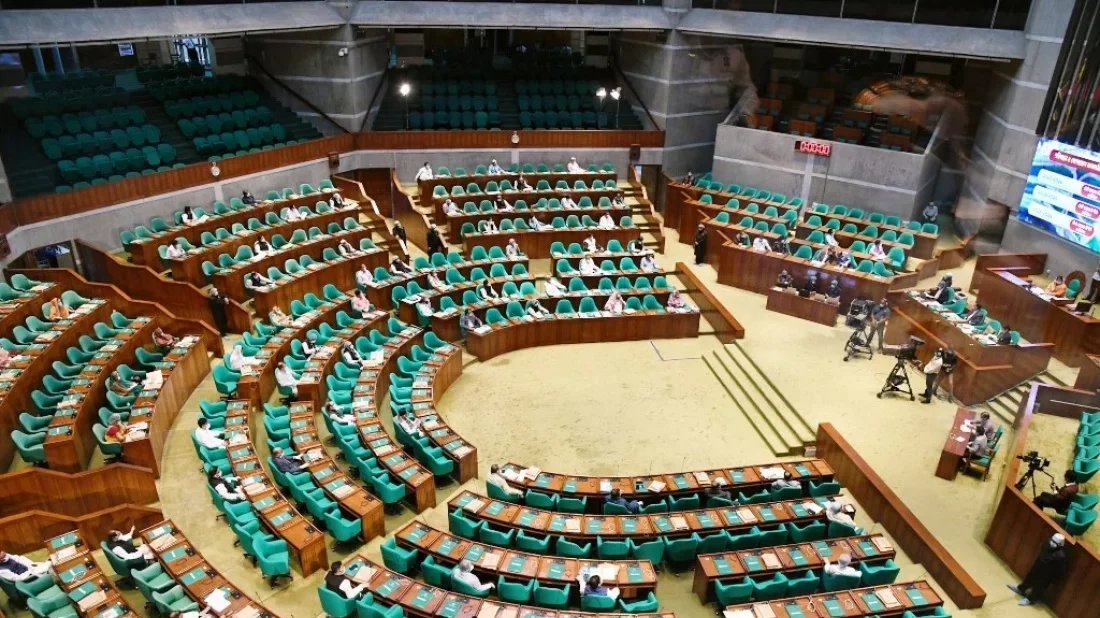
The main problem with the Bangladesh Constitution is that the post of prime minister is too powerful.
This comes about because in our single house system the Jatiyo Sangsad is almost the sole repository of power. As a result whoever is the leader of the majority party has unlimited scope to do whatever he or she wishes without any meaningful counterpoint elsewhere in the system.
This is a formula which is guaranteed to bring about abuses of power. In other words it is the structure of our governance system which is at fault. Certain structures tend to produce certain kinds of dysfunctional behaviour, irrespective of who the individuals concerned are.
Today our politicians may fervently promise that they will not repeat the mistakes of the past but we cannot again take the risk of believing them. We need to change the basic structure of the Constitution to ensure that there will be no future abuses of power.
The theory-checks and balances
The political theory of checks-and-balances emerges out of such concerns. Power relations are so organized that one set of actors pursuing their narrow interests is set against another set who are busy doing the same. In other words power is shared between two or more institutions, which can then be relied upon to guard their prerogatives. In doing so each institution ensures that the others are not permitted complete freedom of action; each institution is made subject to the “checks” of the others.
One of the most illustrative examples of these principles in the modem world is provided by the US Constitution. Its architects had an acute appreciation of the weaknesses of human nature and were careful to design their system with this factor in mind: Given the self-seeking tendencies of people, there must be no centres of absolute power in the United States.
Instead, a carefully balanced arrangement was created in which the various components, the Presidency, the Congress, the Supreme Court, the press were each given some specific powers, like chips in a poker game, and were allowed to jostle for position in a constant, but regulated, struggle.
In other words, because of their constitutional provisions the American system is expected to tend towards equilibrium (though in recent times some huge and damaging distortions have been introduced). By contrast, under the present Bangladesh Constitution, the inherent structure of power relations is so severely biased in favour of a single chamber that the system as a whole cannot help but produce disequilibrium.
Background
The original framers of the Bangladesh Constitution in November 1972, steeped in Anglo-Saxon political traditions as they were, instinctively sprung for the House of Commons model (characterized by an extremely powerful lower house which combines in itself both the legislative and the executive functions of the state).
This was quite understandable as this model was familiar to the political class, the intelligentsia and the common man, having been practiced in British India for nearly a 100 years previously.
When democracy was re-established in Bangladesh in 1990 the backlash against Gen Ershad’s presidential form of government once again propelled the nation into the British parliamentary model. In view of this history we should today carry out our current constitutional reform within the same overall House of Commons framework as it would take too long to habituate the nation to anything drastically different — but of course only after remedying its problems.
The problem is that, as is increasingly becoming evident, the British parliamentary model has remarkably few built-in checks-and-balances. When it works at all it is due to a strong consensus among all the members of the political class about the limits of action. Such a system of self-imposed limits presupposes a highly developed sense of responsibility among the professional politicians of the country, something which is largely absent as yet in modern Bangladesh.
Even in the contemporary United Kingdom, following the emasculation of the parliamentary parties and the decline of the cabinet system, the House of Commons model is more likely to lead to an “elected dictatorship” than anything else. During her years in power, Margaret Thatcher rode roughshod over all centres of potential opposition and was only brought down when her excesses became so grotesque as to provoke violent street demonstrations. Tony Blair barely disguised his contempt for the House of Commons and exploited the weaknesses of the system to foster his personal rule.
In the Bangladesh context such inherent autocratic tendencies have been even more magnified and our experience of the last 20 years has been alarming. The abuses of unchecked power of the recently deposed government, ranging from wholesale election rigging to stealing funds from the banks to the killing of perceived opponents is too fresh in our memory for us ever to allow any repetition.
It takes only a moment of thought to see that each of these ghastly outcomes was only possible because the prime minister had full power to break all the rules and regulations of normal government procedure and could intervene in whichever domain she wished. Accordingly, we have no choice but to introduce a system of checks and balances in the Constitution of Bangladesh 2.0 — but one that is suited to the needs of our nation and its traditions.
The problem is that, as is increasingly becoming evident, the British parliamentary model has remarkably few built-in checks-and-balances
Destabilizing consequences of an over-powerful Jatiyo Sangsad
Another consequence of over-centralization of power is that it promotes political instability. The Jatiyo Sangsad is too powerful, too rich a prize for its own good, a veritable poisoned chalice. Once a political party has gained a simple majority in the Jatiyo Sangsad there is almost nothing to stop the prime minister of Bangladesh from passing any legislative bills, however flawed they may be. In effect the prime minister acquires unlimited executive authority for five years.
There are no alternative centres of power. The president has been reduced to a figurehead. The judiciary, and especially the higher judiciary, has powers of redress over the government’s executive actions but these are tangled up in convoluted procedure and, being essentially after-the-fact in nature, cannot be a substitute for an institution with a true checking role. The free press and media do what they can to expose abuses but are not a source of institutional power.
The field is absolutely clear for the government to act without any checks and what this boils down to in practice is rule by bureaucrats and shadowy advisers usually, but not always, at the behest of the leader.
Winner-takes-all is inherently unstable
In fact it is this winner-takes-all system which is responsible for the ferocity of the combat between the different political forces in the country and their total unwillingness to accommodate each other. The essence of a healthy political system is that it should provide a forum for maneuver, leading to give-and-take between the various political parties and helping them to compromise.
In Bangladesh the party which loses the elections and so loses control over the Jatiyo Sangsad is reduced to zero. In view of the opposition’s utter powerlessness and lack of leverage the ruling party has no incentive whatsoever to accommodate it. No matter how cogent the arguments made by the opposition in any legislative debate in the Jatiyo Sangsad the ruling party can ignore them and proceed on its way unchallenged.
In fact the opposition starts to feel that its only role is as a cipher serving to legitimize all the actions of the governing party. In reaction the opposition looks only for ways to de-legitimize the proceedings of the Jatiyo Sangsad, either by disruptive behaviour in the chamber or by not attending it at all. The opposition starts to believe that the only way to oppose the juggernaut of the executive machinery of the state is to resort to street agitation, hartals and other extra-constitutional methods.
It is worth noting that both the BNP and the Awami League have succumbed to exactly this logic each time they have been in opposition. This is not because both of these parties are irrational but, on the contrary, because, given the political power imbalance in the institutions of Bangladesh, this is the only rational strategy!
Today our politicians may fervently promise that they will not repeat the mistakes of the past but we cannot again take the risk of believing them
A bicameral system
In view of this sorry state of affairs, which is likely to persist in future if changes are not made urgently, a decentralization of the structure of power relations in Bangladesh has become overdue. The simplest change, and the easiest one to bring about, would be to set up an upper house in a form which fits the temper and needs of the polity. This will function side by side with the existing Jatiyo Sangsad (henceforth to be referred to in this paper as the lower house).
It need hardly be pointed out that almost every democratic country in the world has felt the need to ensure that there are at least two legislative houses; in this sense Bangladesh, being a single house system, stands out as a global exception.
Even in the UK, the supposed model for Bangladesh, there exists a House of Lords which, though largely toothless, has played a role at crucial moments in history to counter the excesses of the prime minister of the time. Even more important, by its very presence, the House of Lords plays a deterrent role in the calculations of British political leaders of the House of Commons, who are forced to think twice before they even propose legislation which is too drastic or unreasonable.
The upper house should be like a ‘permanent caretaker government’
Once it is accepted that there should be a bicameral system in Bangladesh we need to specify what form it should take. It would not be wise to simply copy systems in existence elsewhere. We need to find a format which has some existing base of familiarity in Bangladesh and which can fulfill the functions expected of it, namely to provide a check upon the otherwise unlimited power of the lower house.
The writer’s opinion is that in Bangladesh we should try to build on that aspect of our constitutional history which has been a truly original, and largely successful, development, namely the concept of the “caretaker government.”
In this view the future upper house of Bangladesh should not be yet another forum made up of professional politicians who have been elected under the auspices of one political party or another. Rather it should consist of a nominated “council of elders” which is effectively what the caretaker governments of the past have most resembled.
The novelty this time would be that such a council should not be restricted only to managing the electoral process but should have other crucial functions as well. These functions would be mainly those of oversight, to ensure that the legislative and executive authorities follow the laws and rules of the country, and do not stray from them.
In symbolic language the upper house would play the role of a referee so that the “game of politics” does not become an unregulated chaos in which one side gets to favour itself while leaving all the others helpless to react.
Salahdin Imam is a Harvard graduate in political and social science with a special interest in Comparative Social Theory. Email: salimam32@yahoo.com