Islam and the search for truth are not mutually exclusive. This is part two of a three-part long form piece
The current thinking is that a significant role in evolution is played by what are known as “epigenetic” influences — epigenetic means “beyond genes” which by definition means that the “exclusively gene-based” neo-Darwinian synthesis is invalid. The latest important books on the subject have titles like Evolution in Four Dimensions (by Eva Jablonka and Marion J Lamb) in which epigenetics is considered a far more efficient channel than natural selection for the propagation of evolution, and other dimensions are also prominent. The notion of epigenetics is particularly subversive in that it tends to show that the watch-maker is not completely blind after all.
Or let us note the following verdict in a book co-authored by a leading scientific thinker, known for his original conceptions: “According to the new systemic under-standing, the unfolding of life on Earth proceeded through three major avenues of evolution. The first, but perhaps least important, is the random mutation of genes, the centre-piece of the neo-Darwinian theory. These gene mutations, caused by chance errors in the self-replication of DNA, do not seem to occur frequently enough to explain the evolution of the great diversity of life forms, given the well-known fact that most mutations are harmful and very few result in useful variations” (The Systems View of Life, by Fritjof Capra and Pier Luigi Luisi)
Another relevant book, What Darwin Got Wrong by Jerry Fodor and Massimo Piatelli-Palmarini, who are both avowed atheists, hones in on what are said to be the irredeemable philosophical and logical problems with the very concept of natural selection. In addition, there are a whole host of powerfully argued books by outright sceptics such as Michael Behe, William A Dembski, and Stephen Meyer who use strict rationalist logic to show that natural selection is not a useful way of explaining the mechanism which is driving evolution without, however, offering any alternative systematic answers of their own.
It is to be supposed, therefore, that we can all agree that the picture has become extremely complex and, despite the impression given to the general public, the scientific community today does not have a clear idea about how biological evolution takes place. For example, while strong epigenetic influences have been detected, no one as yet knows much more about how these are orchestrated to produce the wondrous results of evolution that we see all around us.
It seems certainly true to say that natural selection, and its concomitant dependence on entirely random processes, has been seriously discredited as the sole answer to this riddle. It only remains to point out that if the arch stone of the atheistic conception is the theory of natural selection, does not the whole edifice totter now that its arch stone has been knocked out?
The Big Bang
Let us turn now to the greatest natural phenomenon known to humans, in terms of its scale and power, the origin of the Universe itself! Quite understandably, this subject is also redolent with theological implications and, as we will see, the story that has emerged is perfectly suitable for
just such speculation. There have been many books written about this topic but I particularly recommend Big Bang by Simon Singh.
Early modern scientific thought held that the Universe existed in a steady state, as if it was just there, and had been for eons, with-out any apparent beginning. Some scientists, however, proposed a dynamic model incorporating a definite beginning. In the 1920s it was discovered that the light from distant galaxies seemed to display a phenomenon known as the “red shift,” which proved that these galaxies were all moving away from us. This implied that the universe as a whole was expanding in every direction.
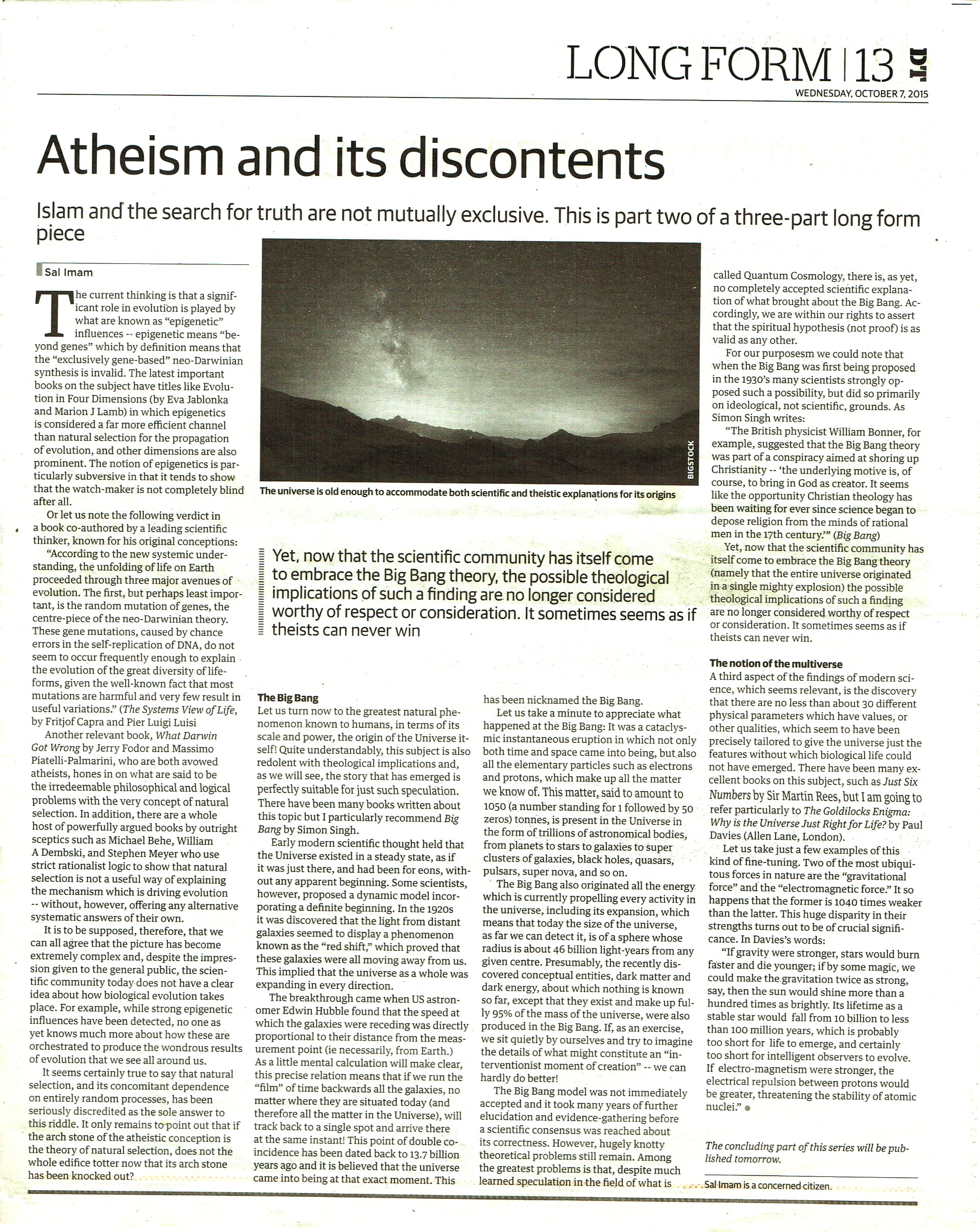
The breakthrough came when US astronomer Edwin Hubble found that the speed at which the galaxies were receding was directly proportional to their distance from the measurement point (ie necessarily, from Earth.) As a little mental calculation will make clear, this precise relation means that if we run the “film” of time backwards all the galaxies, no matter where they are situated today (and therefore all the matter in the Universe), will track back to a single spot and arrive there at the same instant! This point of double coincidence has been dated back to 13.7 billion years ago and it is believed that the universe came into being at that exact moment. This has been nicknamed the Big Bang.
Let us take a minute to appreciate what happened at the Big Bang: It was a cataclysmic instantaneous eruption in which not only both time and space came into being, but also all the elementary particles such as electrons and protons, which make up all the matter we know of. This matter, said to amount to 1050 (a number standing for 1 followed by 50 zeros) tonnes, is present in the Universe in the form of trillions of astronomical bodies, from planets to stars to galaxies to super dusters of galaxies, black holes, quasars, pulsars, super nova, and so on.
The Big Bang also originated all the energy which is currently propelling every activity in the universe, including its expansion, which means that today the size of the universe, as far we can detect it, is of a sphere whose radius is about 46 billion light-years from any given centre. Presumably, the recently discovered conceptual entities, dark matter and dark energy, about which nothing is known so far, except that they exist and make up fully 95% of the mass of the universe, were also produced in the Big Bang. If, as an exercise, we sit quietly by ourselves and try to imagine the details of what might constitute an “interventionist moment of creation” we can hardly do better!
The Big Bang model was not immediately accepted and it took many years of further elucidation and evidence-gathering before a scientific consensus was reached about its correctness. However, hugely knotty theoretical problems still remain. Among the greatest problems is that, despite much learned speculation in the field of what is called Quantum Cosmology, there is, as yet, no completely accepted scientific explanation of what brought about the Big Bang.
Accordingly, we are within our rights to assert that the spiritual hypothesis (not proof) is as valid as any other.
For our purpose we could note that when the Big Bang was first being proposed in the 1930’s many scientists strongly opposed such a possibility, but did so primarily on ideological, not scientific, grounds. As Simon Singh writes: “The British physicist William Bonner, for example, suggested that the Big Bang theory was part of a conspiracy aimed at shoring up Christianity ‘the underlying motive is, of course, to bring in God as creator. It seems like the opportunity Christian theology has been waiting for ever since science began to depose religion from the minds of rational men in the 17th century.” (Big Bang)
Yet, now that the scientific community has itself come to embrace the Big Bang theory (namely that the entire universe originated in a single mighty explosion) the possible theological implications of such a finding are no longer considered worthy of respect or consideration. It sometimes seems as if theists can never win.
The notion of the multiverse
A third aspect of the findings of modern science, which seems relevant, is the discovery that there are no less than about 30 different physical parameters which have values, or other qualities, which seem to have been precisely tailored to give the universe just the features without which biological life could not have emerged. There have been many excellent books on this subject, such as Just Six Numbers by Sir Martin Rees, but I am going to refer particularly to The Goldilocks Enigma: Why is the Universe Just Right for Life? by Paul Davies (Allen Lane, London).
Let us take just a few examples of this kind of fine-tuning. Two of the most ubiquitous forces in nature are the “gravitational force” and the “electromagnetic force.” It so happens that the former is 1040 times weaker than the latter. This huge disparity in their strengths turns out to be of crucial significance. In Davies’s words: “If gravity were stronger, stars would burn faster and die younger; if by some magic, we could make the gravitation twice as strong, say, then the sun would shine more than a hundred times as brightly. Its lifetime as a stable star would fall from 10 billion to less than 100 million years, which is probably too short for life to emerge, and certainly too short for intelligent observers to evolve. If electro-magnetism were stronger, the electrical repulsion between protons would be greater, threatening the stability of atomic nuclei.”
(Continued)
Sal Imam is a concerned citizen.