Islam and the search for truth are not mutually exclusive. This is the final part of a three-part long form piece
At the sub-atomic level too there are exact dependencies. Neutrons and protons are the constituents of every atomic nucleus, and electrons and neutrinos are fundamental particles. As Davies describes it in Goldilocks:
“The fact that the neutron’s mass is coincidentally just a little bit more than the combined mass of the proton, electron, and neutrino is what enables free neutrons to decay. If the neutron were even very slightly lighter, it could not decay without an energy input of some sort. If the neutron were lighter still, yet only by a fraction of 1%, it would have less mass than the proton, and the tables would be turned; it would be isolated protons rather than neutrons that would be unstable. Then protons would decay into neutrons and positrons, with disastrous consequences for life, because without protons there could be no atoms, and no chemistry.”
We can call on Stephen Hawking too. In his best-selling book, A Brief History of Time, he states: “The remarkable fact is that the values of these numbers seem to have been very finely adjusted to make possible the development of life. For example, if the electric charge of the electron had been only slightly different, stars either would have been unable to burn hydrogen and helium or else they would not have exploded,” meaning that there would have been no way of generating heavy elements.
From this he deduced that “it seems clear that there are relatively few ranges of values for the numbers that would allow for the development of any form of intelligent life. Most sets of values would give rise to universes that, although they might be very beautiful, would contain no one able to wonder at that beauty.”
Many other such precise coincidences have been found (some particularly amazing ones in the field of cosmology) as discussed in the books cited above and other sources. When these numerous unexplained coincidences were considered all together, the scientific community could no longer avoid the conclusion that the universe seemed to have been actually designed to facilitate the emergence of life.
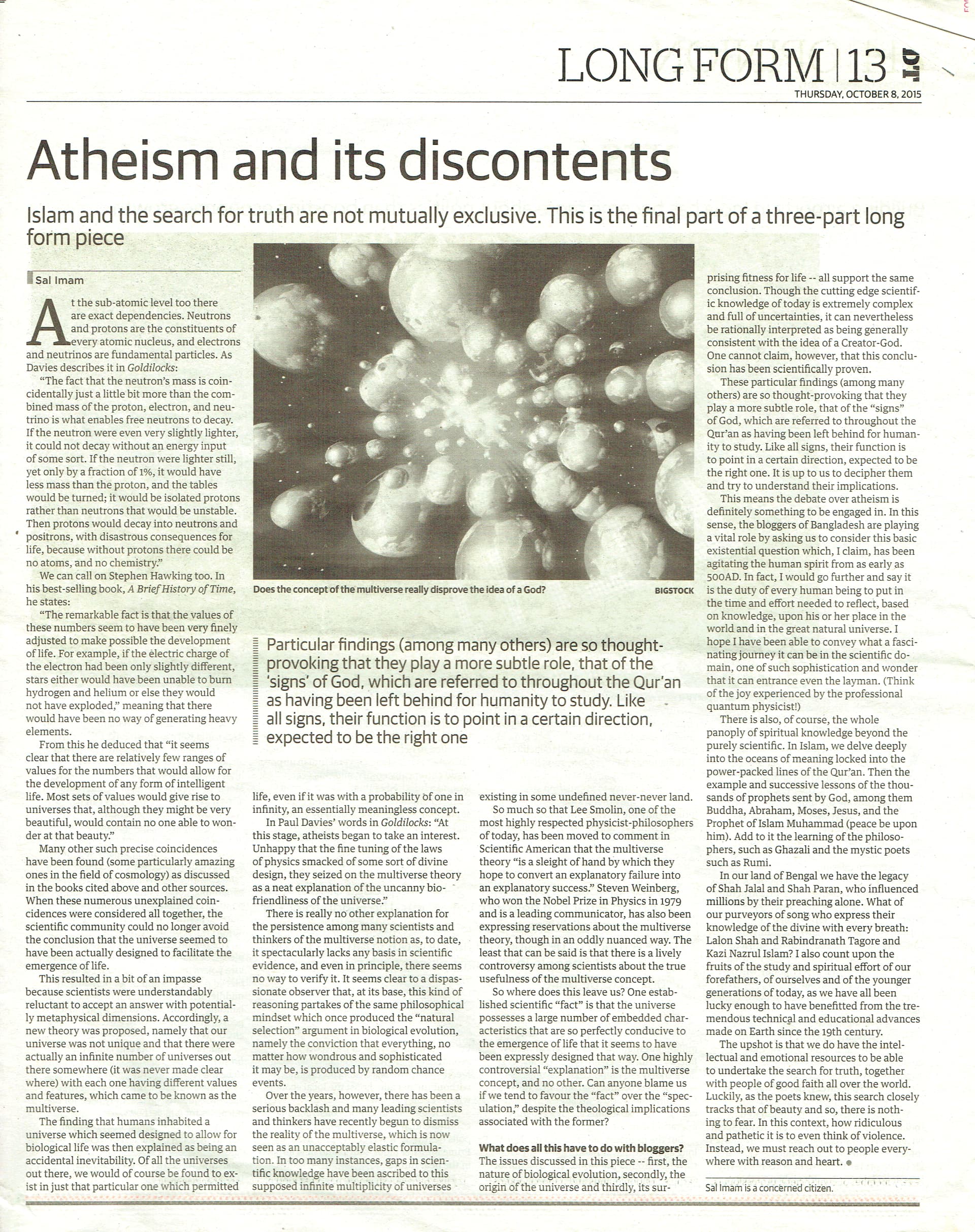
This resulted in a bit of an impasse because scientists were understandably reluctant to accept an answer with potentially metaphysical dimensions. Accordingly, a new theory was proposed, namely that our universe was not unique and that there were actually an infinite number of universes out there somewhere (it was never made clear where) with each one having different values and features, which came to be known as the multiverse.
The finding that humans inhabited a universe which seemed designed to allow for biological life was then explained as being an accidental inevitability. Of all the universes out there, we would of course be found to exist in just that particular one which permitted life, even if it was with a probability of one in infinity, an essentially meaningless concept.
In Paul Davies’ words in Goldilocks: “At this stage, atheists began to take an interest. Unhappy that the fine tuning of the laws of physics smacked of some sort of divine design, they seized on the multiverse theory as a neat explanation of the uncanny bio-friendliness of the universe.”
There is really no other explanation for the persistence among many scientists and thinkers of the multiverse notion as, to date, it spectacularly lacks any basis in scientific evidence, and even in principle, there seems no way to verify it. It seems clear to a dispassionate observer that, at its base, this kind of reasoning partakes of the same philosophical mindset which once produced the “natural selection” argument in biological evolution, namely the conviction that everything, no matter how wondrous and sophisticated it may be, is produced by random chance events.
Over the years, however, there has been a serious backlash and many leading scientists and thinkers have recently begun to dismiss the reality of the multiverse, which is now seen as an unacceptably elastic formulation. In too many instances, gaps in scientific knowledge have been ascribed to this supposed infinite multiplicity of universes existing in some undefined never-never land.
So much so that Lee Smolin, one of the most highly respected physicist-philosophers of today, has been moved to comment in Scientific American that the multiverse theory “is a sleight of hand by which they hope to convert an explanatory failure into an explanatory success.” Steven Weinberg, who won the Nobel Prize in Physics in 1979 and is a leading communicator, has also been expressing reservations about the multiverse theory, though in an oddly nuanced way. The least that can be said is that there is a lively controversy among scientists about the true usefulness of the multiverse concept.
So where does this leave us? One established scientific “fact” is that the universe possesses a large number of embedded characteristics that are so perfectly conducive to the emergence of life that it seems to have been expressly designed that way. One highly controversial “explanation” is the multiverse concept, and no other. Can anyone blame us if we tend to favour the “fact” over the “speculation;’ despite the theological implications associated with the former?
What does all this have to do with bloggers?
The issues discussed in this piece — first, the nature of biological evolution, secondly, the origin Of the universe and thirdly, its surprising fitness for life–all support the same conclusion. Though the cutting edge scientific knowledge of today is extremely complex and full of uncertainties, it can nevertheless be rationally interpreted as being generally consistent with the idea of a Creator-God. One cannot claim, however, that this conclusion has been scientifically proven.
These particular findings (among many others) are so thought-provoking that they play a more subtle role, that of the “signs” of God, which are referred to throughout the Qur’an as having been left behind for humanity to study. Like all signs, their function is to point in a certain direction, expected to be the right one. It is up to us to decipher them and try to understand their implications.
This means the debate over atheism is definitely something to be engaged in. In this sense, the bloggers of Bangladesh are playing a vital role by asking us to consider this basic existential question which, I claim, has been agitating the human spirit from as early as 500 AD. In fact, I would go further and say it is the duty of every human being to put in the time and effort needed to reflect, based on knowledge, upon his or her place in the world and in the great natural universe. I hope I have been able to convey what a fascinating journey it can be in the scientific domain, one of such sophistication and wonder that it can entrance even the layman. (Think of the joy experienced by the professional quantum physicist!)
There is also, of course, the whole panoply of spiritual knowledge beyond the purely scientific. In Islam, we delve deeply into the oceans of meaning locked into the power-packed lines of the Qur’an. Then the example and successive lessons of the thousands of prophets sent by God, among them Buddha, Abraham, Moses, Jesus, and the Prophet of Islam Muhammad (peace be upon him). Add to it the learning of the philosophers, such as Ghazali and the mystic poets such as Rumi.
In our land of Bengal we have the legacy of Shah Jalal and Shah Paran, who influenced millions by their preaching alone. What of our purveyors of song who express their knowledge of the divine with every breath: Lalon Shah and Rabindranath Tagore and Kazi Nazrul Islam? I also count upon the fruits of the study and spiritual effort of our forefathers, of ourselves and of the younger generations of today, as we have all been lucky enough to have benefitted from the tremendous technical and educational advances made on Earth since the 19th century.
The upshot is that we do have the intellectual and emotional resources to be able to undertake the search for truth, together with people of good faith all over the world. Luckily, as the poets knew, this search closely tracks that of beauty and so, there is nothing to fear. In this context, how ridiculous and pathetic it is to even think of violence. Instead, we must reach out to people everywhere with reason and heart.
Sal Imam is a concerned citizen.