It shouldn’t be difficult for Modi to mobilise global support
Just got back from Delhi a few days ago, and I’m still slightly reeling from the blow of its huge blast. The towering government offices which house India’s civil and military establishment, South Block and its ilk, have shed the dusty sleepiness I remember from past visits and have become re-energised, like golden lions raising their heads.
The wide boulevards of the city have never seemed more portentous. The Delhi international airport gleams with up-to-date bling and is also efficiently run — my luggage was already on the conveyer belt by the time I reached it.Pictures of the demi-gods who dominate the Indian scene are everywhere, from Virat Kohli and his warriors, to Anushka Sharma and the thespians, who bring excitement and inspiration to a billion people.
My publisher’s driver, who took me around with unfailing enthusiasm while I was in Delhi, couldn’t contain himself one day and burst out unbidden: “Modi-ji is fixing this country.”
This is such a staple of the ruling BJP’s propaganda machine that I wondered if my driver was just someone who had been brainwashed, but his sincerity was such that I had to acknowledge that this was probably not the case. Even when I probed about the chaos caused by demonetisation, he had a ready answer: “Yes, there was some difficulty but nothing to worry about. Modi-ji is doing good work”
I suddenly understood the source of the nation’s new-found confidence and its feelings of burgeoning might. Indian Prime Minister Modi has definitely caught the imagination of the masses and has put himself at the head of a vast population, imbuing them with purpose.
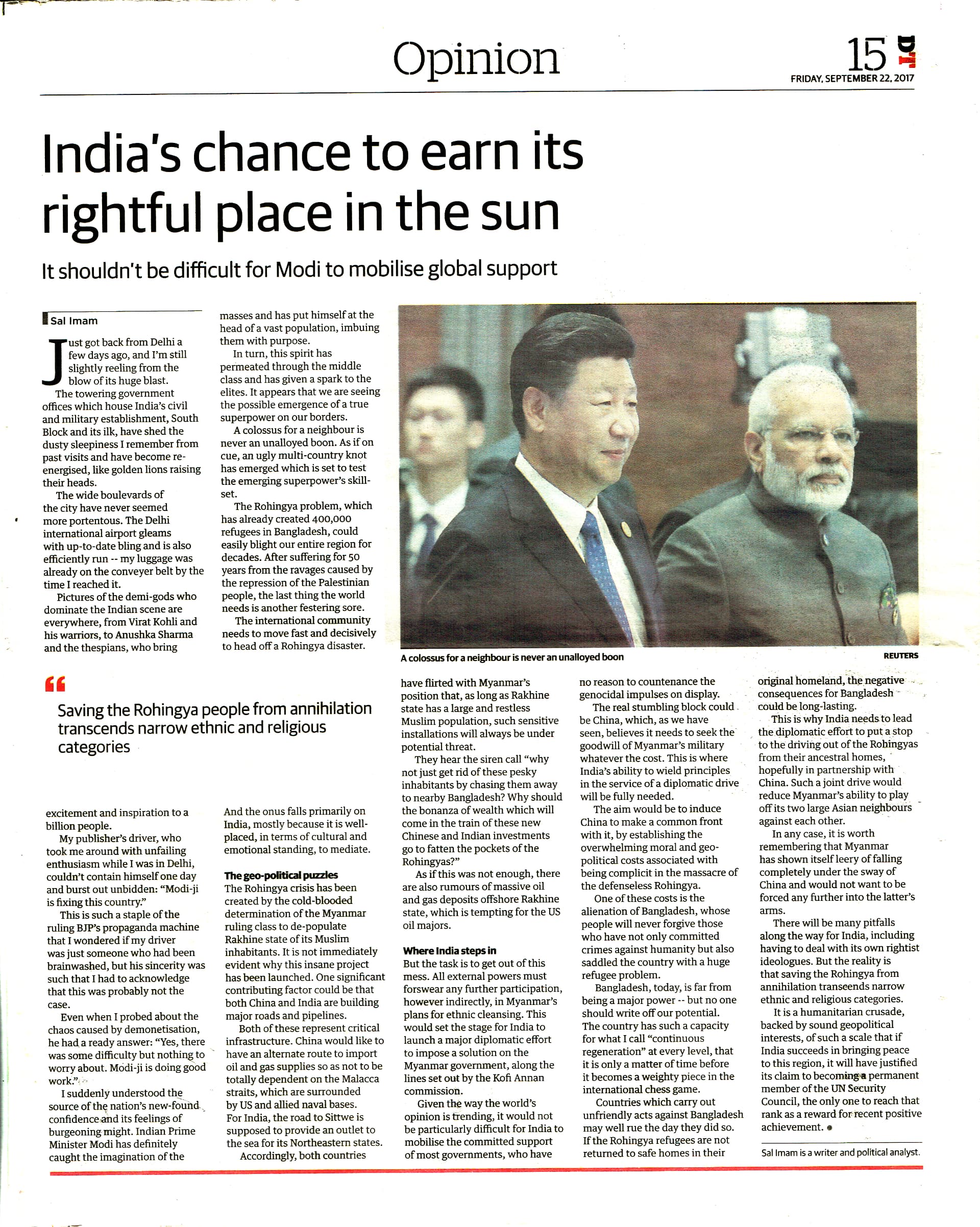
In turn, this spirit has permeated through the middle class and has given a spark to the elites. It appears that we are seeing the possible emergence of a true superpower on our borders. A colossus for a neighbour is never an unalloyed boon. As if on cue, an ugly multi-country knot has emerged which is set to test the emerging superpower’s skillset.
The Rohingya problem, which has already created 400,000 refugees in Bangladesh, could easily blight our entire region for decades. After suffering for 50 years from the ravages caused by the repression of the Palestinian people, the last thing the world needs is another festering sore. The international community needs to move fast and decisively to head off a Rohingya disaster. And the onus falls primarily on India, mostly because it is well-placed, in terms of cultural and emotional standing, to mediate.
The geo-political puzzles
The Rohingya crisis has been created by the cold-blooded determination of the Myanmar ruling class to de-populate Rakhine state of its Muslim inhabitants. It is not immediately evident why this insane project has been launched. One significant contributing factor could be that both China and India are building major roads and pipelines. Both of these represent critical infrastructure. China would like to have an alternate route to import oil and gas supplies so as not to be totally dependent on the Malacca straits, which are surrounded by US and allied naval bases. For India, the road to Sittwe is supposed to provide an outlet to the sea for its Northeastern states.
Accordingly, both countries have flirted with Myanmar’s position that, as long as Rakhine state has a large and restless Muslim population, such sensitive installations will always be under potential threat. They hear the siren call “why not just get rid of these pesky inhabitants by chasing them away to nearby Bangladesh? Why should the bonanza of wealth which will come in the train of these new Chinese and Indian investments go to fatten the pockets of the Rohingyas?” As if this was not enough, there are also rumours of massive oil and gas deposits offshore Rakhine state, which is tempting for the US oil majors.
Where India steps in
But the task is to get out of this mess. All external powers must forswear any further participation, however indirectly, in Myanmar’s plans for ethnic cleansing. This would set the stage for India to launch a major diplomatic effort to impose a solution on the Myanmar government, along the lines set out by the Kofi Annan commission. Given the way the world’s opinion is trending, it would not be particularly difficult for India to mobilise the committed support of most governments, who have no reason to countenance the genocidal impulses on display.
The real stumbling block could be China, which, as we have seen, believes it needs to seek the goodwill of Myanmar’s military whatever the cost. This is where India’s ability to wield principles in the service of a diplomatic drive will be fully needed. The aim would be to induce China to make a common front with it, by establishing the overwhelming moral and geo-political costs associated with being complicit in the massacre of the defenseless Rohingya.
One of these costs is the alienation of Bangladesh, whose people will never forgive those who have not only committed crimes against humanity but also saddled the country with a huge refugee problem. Bangladesh, today, is far from being a major power but no one should write off our potential. The country has such a capacity for what I call “continuous regeneration” at every level, that it is only a matter of time before it becomes a weighty piece in the international chess game.
Countries which carry out unfriendly acts against Bangladesh may well rue the day they did so. If the Rohingya refugees are not returned to safe homes in their original homeland, the negative consequences for Bangladesh could be long-lasting.
This is why India needs to lead the diplomatic effort to put a stop to the driving out of the Rohingyas from their ancestral homes, hopefully in partnership with China. Such a joint drive would reduce Myanmar’s ability to play off its two large Asian neighbours against each other. In any case, it is worth remembering that Myanmar has shown itself leery of falling completely under the sway of China and would not want to be forced any further into the latter’s arms.
There will be many pitfalls along the way for India, including having to deal with its own rightist ideologues. But the reality is that saving the Rohingya from annihilation transcends narrow ethnic and religious categories. It is a humanitarian crusade, backed by sound geopolitical interests, of such a scale that if India succeeds in bringing peace to this region, it will have justified its claim to becoming permanent member of the UN Security Council, the only one to reach that rank as a reward for recent positive achievement.
Sal Imam is a writer and political analyst.