If a process as crucial as the January 5 election is flawed in a basic way, all sorts of undesirable consequences arise that we cannot, and should not, countenance
AQ Shamim
“Things fall apart; the centre cannot hold; Mere anarchy is loosed upon the world .The best lack all conviction, while the worst are full of passionate intensity” – WB Yeats
After last year’s wholesale social chaos and economic disruption there is an understandable tendency to overlook the Awami League’s power grab of January 5, and just get on with one’s own business and personal life. I myself have been strongly tempted to do so, particularly as the possible alternative of BNP rule doesn’t inspire confidence.
However, we all need to resist this urge to embrace relief in the short-term because the long-term consequences of the fake general election (labelled with devastating accuracy a “selection” rather than an “election”) are so dangerous that the Bangladesh polity as a whole just cannot afford to treat it as a fait accompli. Let there be no doubt: the country has been placed on a slippery slope and unless a determined effort is made to reverse the slide, it could go all the way into the abyss.
In the first place, let us clearly understand what the January 5 selection has brought about: it has shaken the very bedrock of the democratic system of our beloved country and left it devoid of accountability. There is an ingrained understanding among the masses, not just the elite, of this country that democracy allows us to judge the actions of our rulers and gives us the absolute, inalienable right to remove them from office if so desired. This fundamental right was denied to the people in the farce enacted on January 5.
Sheikh Hasina did not allow anyone to hold her accountable for her actions in her last five-year term. And there is absolutely no reason to believe, especially after the conduct of the last rounds of the upazila elections, that five years from now, in 2019, this mechanism will not be further twisted in such a way that accountability will be even more of a dream than it is today.
This is the bone that is stuck in our throats and cannot be easily swallowed. Sheikh Hasina certainly feels that she is the only person who is capable of leading Bangladesh to prosperity (she may even be right about this), but democracy means that she cannot impose this decision on her subjects; she cannot shove this bone down our throats.
What is the harm, people may ask, of a flawed process if you end up with a desirable result? But that is exactly the point of this piece, namely to show that because the process is flawed in this basic way, all sorts of such undesirable consequences arise that we cannot, and should not, countenance.
It is worth recalling what lack of accountability really means. It means that the ruling politicians can take any action they want to without any check, and without fearing the consequences. For example, they could declare the country a monarchy, or sign unequal treaties with foreign powers, or seize any person’s private property, and because they are not accountable, no one could lift a finger to prevent them.
Clearly, these are exaggerations, used by me in order to make a point, but given the actual history of the last few years in which we have seen the caretaker government system summarily abolished, and the egregious decision to place a power plant in the Sundarbans, the exaggeration is not by much.
Of course, we could rely on our politicians being wise and sensible enough not to take extreme measures in the future, despite never being held to account. But this is not the way a modern political system should be organised. It is intolerable that the people of this country should have no option but to have blind faith in their rulers and should have no systemic means of redress available to them.
This complete powerlessness to affect the nation’s political fate spills over dangerously into the economic arena as well. I was talking to a leading garment manufacturer recently, and he confided that he has cancelled all his investment plans and is pushing hard to maintain a completely liquid position with all his assets.
This perception, which is probably widely shared throughout the business community, is due to the lingering uncertainty created by an environment in which the government can do anything it likes, with literally nothing barred. Foreign direct investment will likely be even shier.
As a result of this twin cooling off, the economic boom which was widely predicted for Bangladesh if we had held a halfway decent general election early this year will have been stopped in its tracks (and perhaps that was the idea). Business investors want, above all, a reliable and organised system of social relations, with a politically accountable government at its core.
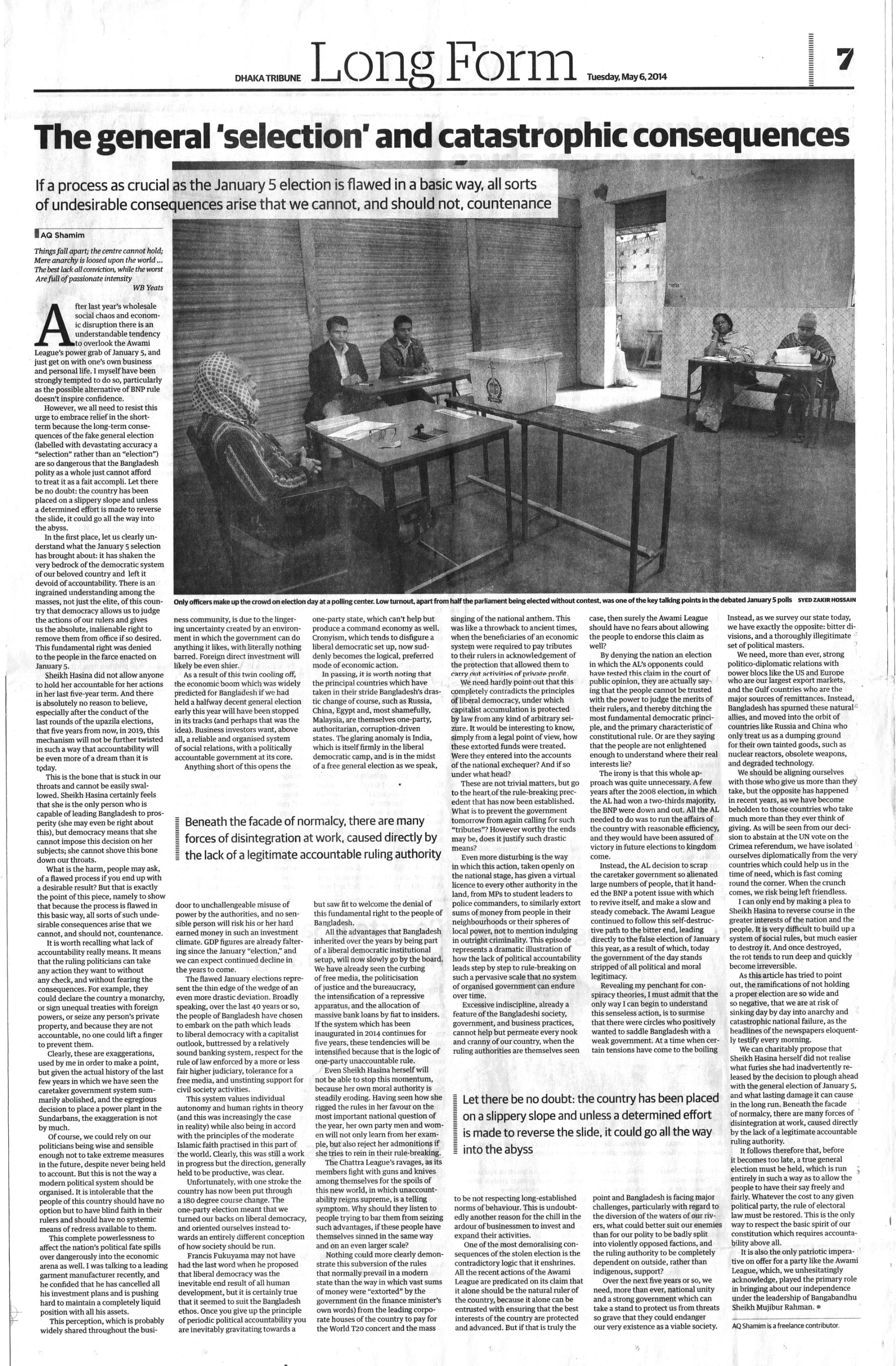
Only officers make up the crowd on election day at a polling center. Low turnout, apart from half the parliament being elected without contest, was one of the key talking points in the debated Januarys polls SYED ZAKIR HOSSAIN
Anything short of this opens the door to unchallengeable misuse of power by the authorities, and no sensible person will risk his or her hard earned money in such an investment climate. GDP figures are already faltering since the January “election,” and we can expect continued decline in the years to come.
The flawed January elections represent the thin edge of the wedge of an even more drastic deviation. Broadly speaking, over the last 40 years or so, the people of Bangladesh have chosen to embark on the path which leads to liberal democracy with a capitalist outlook, buttressed by a relatively sound banking system, respect for the rule of law enforced by a more or less fair higher judiciary, tolerance for a free media, and unstinting support for civil society activities.
This system values individual autonomy and human rights in theory (and this was increasingly the case in reality) while also being in accord with the principles of the moderate Islamic faith practised in this part of the world. Clearly, this was still a work in progress but the direction, generally held to be productive, was clear.
Unfortunately, with one stroke the country has now been put through a 180 degree course change. The one-party election meant that we turned our backs on liberal democracy, and oriented ourselves instead towards an entirely different conception of how society should be run.
Francis Fukuyama may not have had the last word when he proposed that liberal democracy was the inevitable end result of all human development, but it is certainly true that it seemed to suit the Bangladesh ethos. Once you give up the principle of periodic political accountability you are inevitably gravitating towards a one-party state, which can’t help but produce a command economy as well. Cronyism, which tends to disfigure a liberal democratic set up, now suddenly becomes the logical, preferred mode of economic action.
In passing, it is worth noting that the principal countries which have taken in their stride Bangladesh’s drastic change of course, such as Russia, China, Egypt and, most shamefully, Malaysia, are themselves one-party, authoritarian, corruption-driven states. The glaring anomaly is India, which is itself firmly in the liberal democratic camp, and is in the midst of a free general election as we speak, but saw fit to welcome the denial of this fundamental right to the people of Bangladesh.
All the advantages that Bangladesh inherited over the years by being part of a liberal democratic institutional setup, will now slowly go by the board. We have already seen the curbing of free media, the politicisation of justice and the bureaucracy, the intensification of a repressive apparatus, and the allocation of massive bank loans by fiat to insiders. If the system which has been inaugurated in 2014 continues for five years, these tendencies will be intensified because that is the logic of one-party unaccountable rule.
Even Sheikh Hasina herself will not be able to stop this momentum, because her own moral authority is steadily eroding. Having seen how she rigged the rules in her favour on the most important national question of the year, her own party men and women will not only learn from her example, but also reject her admonitions if she tries to rein in their rule-breaking.
The Chattra League’s ravages, as its members fight with guns and knives among themselves for the spoils of this new world, in which unaccountability reigns supreme, is a telling symptom. Why should they listen to people trying to bar them from seizing such advantages, if these people have themselves sinned in the same way and on an even larger scale?
Nothing could more clearly demonstrate this subversion of the rules that normally prevail in a modern state than the way in which vast sums of money were “extorted” by the government (in the finance minister’s own words) from the leading corporate houses of the country to pay for the World T20 concert and the mass singing of the national anthem. This was like a throwback to ancient times, when the beneficiaries of an economic system were required to pay tributes to their rulers in acknowledgement of the protection that allowed them to carry out activities of private profit.
We need hardly point out that this completely contradicts the principles of liberal democracy, under which capitalist accumulation is protected by law from any kind of arbitrary seizure. It would be interesting to know, simply from a legal point of view, how these extorted funds were treated. Were they entered into the accounts of the national exchequer? And if so under what head?
These are not trivial matters, but go to the heart of the rule-breaking precedent that has now been established. What is to prevent the government tomorrow from again calling for such “tributes”? However worthy the ends may be, does it justify such drastic means?
Even more disturbing is the way in which this action, taken openly on the national stage, has given a virtual licence to every other authority in the land, from MPs to student leaders to police commanders, to similarly extort sums of money from people in their neighbourhoods or their spheres of local power, not to mention indulging in outright criminality. This episode represents a dramatic illustration of how the lack of political accountability leads step by step to rule-breaking on such a pervasive scale that no system of organised government can endure over time.
Excessive indiscipline, already a feature of the Bangladeshi society, government, and business practices, cannot help but permeate every nook and cranny of our country, when the ruling authorities are themselves seen to be not respecting long-established norms of behaviour. This is undoubtedly another reason for the chill in the ardour of businessmen to invest and expand their activities.
One of the most demoralising consequences of the stolen election is the contradictory logic that it enshrines. All the recent actions of the Awami League are predicated on its claim that it alone should be the natural ruler of the country, because it alone can be entrusted with ensuring that the best interests of the country are protected and advanced. But if that is truly the case, then surely the Awami League should have no fears about allowing the people to endorse this claim as well?
By denying the nation an election in which the AL’s opponents could have tested this claim in the court of public opinion, they are actually saying that the people cannot be trusted with the power to judge the merits of their rulers, and thereby ditching the most fundamental democratic principle, and the primary characteristic of constitutional rule. Or are they saying that the people are not enlightened enough to understand where their real interests lie?
The irony is that this whole approach was quite unnecessary. A few years after the 2008 election, in which the AL had won a two-thirds majority, the BNP were down and out. All the AL needed to do was to run the affairs of the country with reasonable efficiency, and they would have been assured of victory in future elections to kingdom come.
Instead, the AL decision to scrap the caretaker government so alienated large numbers of people, that it handed the BNP a potent issue with which to revive itself, and make a slow and steady comeback. The Awami League continued to follow this self-destructive path to the bitter end, leading directly to the false election of January this year, as a result of which, today the government of the day stands stripped of all political and moral legitimacy.
Revealing my penchant for conspiracy theories, I must admit that the only way I can begin to understand this senseless action, is to surmise that there were circles who positively wanted to saddle Bangladesh with a weak government. At a time when certain tensions have come to the boiling point and Bangladesh is facing major challenges, particularly with regard to the diversion of the waters of our rivers, what could better suit our enemies than for our polity to be badly split into violently opposed factions, and the ruling authority to be completely dependent on outside, rather than indigenous, support?
Over the next five years or so, we need, more than ever, national unity and a strong government which can take a stand to protect us from threats so grave that they could endanger our very existence as a viable society. Instead, as we survey our state today, we have exactly the opposite: bitter divisions, and a thoroughly illegitimate set of political masters.
We need, more than ever, strong politico-diplomatic relations with power blocs like the US and Europe who are our largest export markets, and the Gulf countries who are the major sources of remittances. Instead, Bangladesh has spurned these natural allies, and moved into the orbit of countries like Russia and China who only treat us as a dumping ground for their own tainted goods, such as nuclear reactors, obsolete weapons, and degraded technology.
We should be aligning ourselves with those who give us more than they take, but the opposite has happened in recent years, as we have become beholden to those countries who take much more than they ever think of giving. As will be seen from our decision to abstain at the UN vote on the Crimea referendum, we have isolated ourselves diplomatically from the very countries which could help us in the time of need, which is fast coming round the corner. When the crunch comes, we risk being left friendless.
I can only end by making a plea to Sheikh Hasina to reverse course in the greater interests of the nation and the people. It is very difficult to build up a system of social rules, but much easier to destroy it. And once destroyed, the rot tends to run deep and quickly become irreversible.
As this article has tried to point out, the ramifications of not holding a proper election are so wide and so negative, that we are at risk of sinking day by day into anarchy and catastrophic national failure, as the headlines of the newspapers eloquently testify every morning.
We can charitably propose that Sheikh Hasina herself did not realise what furies she had inadvertently released by the decision to plough ahead with the general election of January 5, and what lasting damage it can cause in the long run. Beneath the facade of normalcy, there are many forces of disintegration at work, caused directly by the lack of a legitimate accountable ruling authority.
It follows therefore that, before it becomes too late, a true general election must be held, which is run entirely in such a way as to allow the people to have their say freely and fairly. Whatever the cost to any given political party, the rule of electoral law must be restored. This is the only way to respect the basic spirit of our constitution which requires accountability above all.
It is also the only patriotic imperative on offer for a party like the Awami League, which, we unhesitatingly acknowledge, played the primary role in bringing about our independence under the leadership of Bangabandhu Sheikh Mujibur Rahman.
AQ Shamim is a freelance contributor.