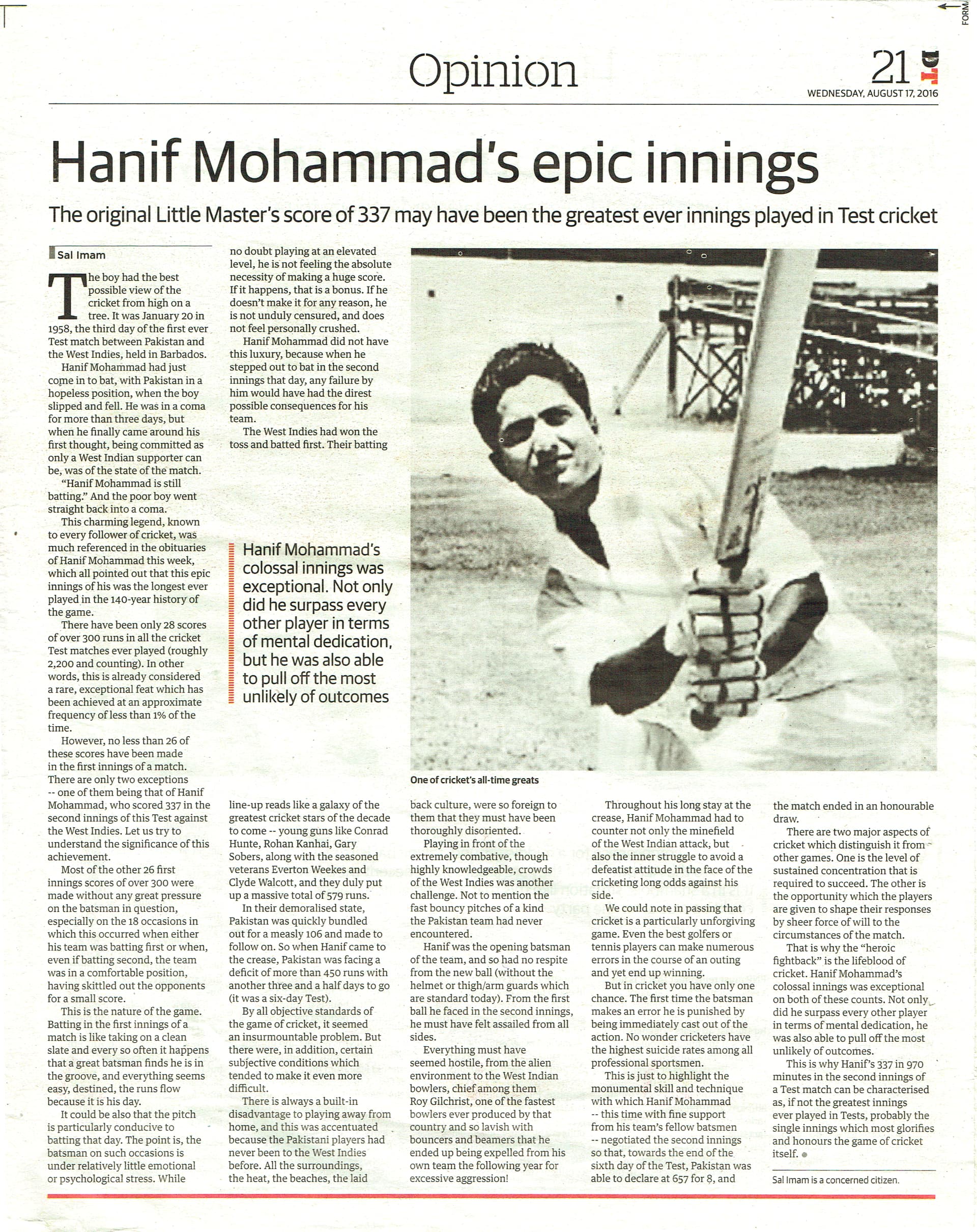
The boy had the best possible view of the cricket from high on a tree. It was January 20 in 1958, the third day of the first ever Test match between Pakistan and the West Indies, held in Barbados.
Hanif Mohammad had just come in to bat, with Pakistan in a hopeless position, when the boy slipped and fell. He was in a coma for more than three days, but when he finally came around his first thought, being committed as only a West Indian supporter can be, was of the state of the match. “Hanif Mohammad is still batting.” And the poor boy went straight back into a coma.
This charming legend, known to every follower of cricket, was much referenced in the obituaries of Hanif Mohammad this week, which all pointed out that this epic innings of his was the longest ever played in the 140-year history of the game.
There have been only 28 scores of over 300 runs in all the cricket Test matches ever played (roughly 2,200 and counting). In other words, this is already considered a rare, exceptional feat which has been achieved at an approximate frequency of less than 1% of the time.
However, no less than 26 of these scores have been made in the first innings of a match. There are only two exceptions — one of them being that of Hanif Mohammad, who scored 337 in the second innings of this Test against the West Indies. Let us try to understand the significance of this achievement.
Most of the other 26 first innings scores of over 300 were made without any great pressure on the batsman in question, especially on the 18 occasions in which this occurred when either his team was batting first or when, even if batting second, the team was in a comfortable position, having skittled out the opponents for a small score.
This is the nature of the game. Batting in the first innings of a match is like taking on a clean slate and every so often it happens that a great batsman finds he is in the groove, and everything seems easy, destined, the runs flow because it is his day.
It could be also that the pitch is particularly conducive to batting that day. The point is, the batsman on such occasions is under relatively little emotional or psychological stress. While no doubt playing at an elevated level, he is not feeling the absolute necessity of making a huge score. If it happens, that is a bonus. If he doesn’t make it for any reason, he is not unduly censured, and does not feel personally crushed.
Hanif Mohammad did not have this luxury, because when he stepped out to bat in the second innings that day, any failure by him would have had the direct possible consequences for his team.
The West Indies had won the toss and batted first. Their batting line-up reads like a galaxy of the greatest cricket stars of the decade to come — young guns like Conrad Hunte, Rohan Kanhai, Gary Sobers, along with the seasoned veterans Everton Weekes and Clyde Walcott, and they duly put up a massive total of 579 runs.
In their demoralised state, Pakistan was quickly bundled out for a measly 106 and made to follow on. So when Hanif came to the crease, Pakistan was facing a deficit of more than 450 runs with another three and a half days to go (it was a six-day Test).
By all objective standards of the game of cricket, it seemed an insurmountable problem. But there were, in addition, certain subjective conditions which tended to make it even more difficult.
There is always a built-in disadvantage to playing away from home, and this was accentuated because the Pakistani players had never been to the West Indies before. All the surroundings, the heat, the beaches, the laid back culture, were so foreign to them that they must have been thoroughly disoriented.
Playing in front of the extremely combative, though highly knowledgeable, crowds of the West Indies was another challenge. Not to mention the fast bouncy pitches of a kind the Pakistan team had never encountered.
Hanif was the opening batsman of the team, and so had no respite from the new ball (without the helmet or thigh/arm guards which are standard today). From the first ball he faced in the second innings, he must have felt assailed from all sides.
Everything must have seemed hostile, from the alien environment to the West Indian bowlers, chief among them Roy Gilchrist, one of the fastest bowlers ever produced by that country and so lavish with bouncers and beamers that he ended up being expelled from his own team the following year for excessive aggression!
Throughout his long stay at the crease, Hanif Mohammad had to counter not only the minefield of the West Indian attack, but also the inner struggle to avoid a defeatist attitude in the face of the cricketing long odds against his side.
We could note in passing that cricket is a particularly unforgiving game. Even the best golfers or tennis players can make numerous errors in the course of an outing and yet end up winning. But in cricket you have only one chance. The first time the batsman makes an error he is punished by being immediately cast out of the action. No wonder cricketers have the highest suicide rates among all professional sportsmen.
This is just to highlight the monumental skill and technique with which Hanif Mohammad — this time with fine support from his team’s fellow batsmen — negotiated the second innings so that, towards the end of the sixth day of the Test, Pakistan was able to declare at 657 for 8, and the match ended in an honourable draw.
There are two major aspects of cricket which distinguish it from other games. One is the level of sustained concentration that is required to succeed. The other is the opportunity which the players are given to shape their responses by sheer force of will to the circumstances of the match.
That is why the “heroic fightback” is the lifeblood of cricket. Hanif Mohammad’s colossal innings was exceptional on both of these counts. Not only did he surpass every other player in terms of mental dedication, he was also able to pull off the most unlikely of outcomes.
This is why Hand’s 337 in 970 minutes in the second innings of a Test match can be characterised as, if not the greatest innings ever played in Tests, probably the single innings which most glorifies and honours the game of cricket itself.
Sal Imam is a concerned citizen.